
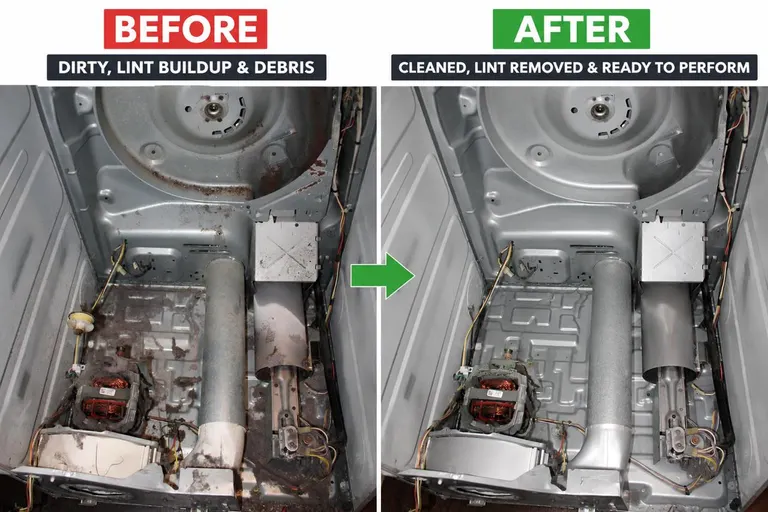
A dryer needs more than heat and a turning drum. It also needs a clear path to move warm, moisture-filled air from the appliance to the outdoors. Lint that passes the screen can collect in the transition duct, the vent pipe inside the wall and the exterior termination. As airflow drops, clothing may take longer to dry and the dryer can run hotter than intended.
A yearly professional cleaning is a practical starting point for many households, but it is not a guarantee that every vent can wait twelve months. The correct interval depends on the dryer, how often it runs, the length and shape of the exhaust route, the duct material, pets, and how quickly warning signs appear. The appliance manual and local building requirements should always take priority.
Clean the lint screen after every load
The most important routine step happens before or after each cycle: remove lint from the dryer's lint screen. A blocked screen restricts airflow immediately. It can also allow more lint to move into places that are harder to reach.
Pull the screen out according to the manufacturer's instructions, remove the lint by hand and reinstall it fully. If fabric-softener residue coats the mesh, the manual may recommend washing the screen with warm water and a soft brush. Let it dry completely before it goes back into the dryer. Never operate the appliance without the lint screen.
While the screen is out, look into the accessible housing with a flashlight. Do not push tools deep into the dryer, remove panels or reach toward wiring. A small vacuum attachment may be appropriate only if the owner's manual permits it and the dryer is off.
What makes one dryer vent fill faster than another?
Two similar households can need different cleaning schedules. These conditions often speed up accumulation or make a restriction more consequential:
- Frequent laundry: Large families, short-term rentals and homes washing many towels produce more lint and run more cycles.
- Long exhaust routes: A dryer on an interior wall may vent through a long run before reaching outdoors.
- Multiple bends: Each elbow adds resistance and creates another place where material can settle.
- Crushed transition duct: A dryer pushed too close to the wall can reduce the open area behind it.
- Pet hair and bulky fabrics: Pet bedding, blankets and towels can shed heavily.
- A blocked exterior hood: Lint, debris, nests or a stuck flap can prevent air from leaving.
If the vent route is long, concealed, routed through the roof or difficult to reach safely, use a qualified dryer-vent professional rather than trying to clean it with improvised tools.
Warning signs that the vent may need attention now
Do not wait for an annual reminder if the dryer's behavior changes. Common airflow warning signs include:
- Loads taking more than one normal cycle to dry
- Clothing or the laundry room feeling unusually hot
- The dryer stopping before clothes are dry
- A burning or overheated odor
- Visible lint collecting behind the dryer or around the exterior hood
- Weak airflow at the exterior outlet while the dryer runs
- The exterior flap failing to open normally
Safe checks a homeowner can perform
1. Inspect the lint screen
Confirm that the screen is clean, undamaged and seated correctly. A torn screen should be replaced with the correct part for the model because lint can pass through the opening.
2. Look behind the dryer without forcing it
If the connection is visible without moving the appliance, check whether the transition duct is crushed, sharply kinked or disconnected. Do not pull a heavy dryer forward when the gas connection, power cord or vent has little slack. Gas dryers and tight installations should be handled by qualified professionals.
3. Check the exterior outlet from the ground
When the dryer runs, the flap should generally open and warm air should exit. Observe only from a safe, accessible location. Do not climb onto a roof or use an unstable ladder to reach a vent termination.
4. Compare one normal load
Use the same cycle and a typical load after cleaning the lint screen. If drying time remains much longer than before, stop assuming the screen is the entire problem. The vent may be restricted, or the dryer may have a heating, sensor, control or mechanical fault.
Vent restriction and dryer failure can look similar
Long dry times do not automatically prove that the heating element, gas igniter or thermal fuse has failed. Restricted airflow can produce poor drying even when the heat source works. On the other hand, a clear vent will not correct a failed heater, thermostat, sensor, motor or control.
A qualified technician evaluates the appliance and airflow together. Diagnosis may include observing cycle behavior, checking temperature changes, inspecting accessible internal components after safe disassembly, and determining whether the problem belongs to the dryer, the building vent or both. This prevents replacing a part while the original airflow problem remains.
Quality Repairs provides dryer repair in Humble and the Lake Houston area for no-heat, long-dry-time, noise and shutdown concerns. Building exhaust cleaning may require a dedicated vent-cleaning provider depending on the route and condition.
How to set a practical maintenance schedule
Start with the manufacturer's care instructions. Clean the lint screen every load, look behind the appliance and at the exterior outlet periodically, and schedule a full vent inspection or cleaning about annually as a baseline. Move the date earlier when drying slows, the route is long, laundry volume is high or previous service found heavy buildup.
Record the last cleaning date near the laundry area or in a home-maintenance calendar. Also note any change in drying time. A consistent baseline makes it easier to recognize a developing problem before repeated long cycles become normal.
When to call for dryer service
Call a professional when basic lint-screen care does not restore normal drying, when the dryer has no heat, when it shuts off early, when the drum makes unusual noise, or when any electrical or burning warning appears. Have the model number, fuel type, main symptom and vent-cleaning history ready.
If you are in Humble, Atascocita or Kingwood, call Quality Repairs or request service online. A technician can diagnose the appliance; if the building vent needs separate specialty work, that should be addressed before the dryer returns to regular use.